Thought Leadership
Agent Collaboration Protocol: How Teams of AI Agents Can Work Together, from Creative Work to ERP
Real work is team work, yet most AI products still hand the whole job to one agent. Our new white paper proposes the Agent Collaboration Protocol (ACoP), an open, vendor-neutral standard for owner-governed teams of AI agents, including department agents working on one ERP.
Explainer
Presented by an AI presenter. Written and reviewed by Cendien.
Read the transcript
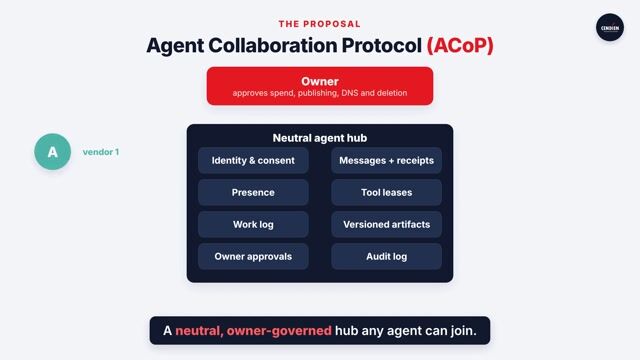
Real work is team work. So why do most AI tools hand the entire job to a single agent? Today, one generalist agent researches, writes, designs, prices and reviews. It looks great in a demo. But on substantive work, quality drops at every hand-off. Add a second agent from another vendor, and they can't see each other. They collide on the same tool, overwrite each other's work, and no one approved the spend. Cendien proposes the Agent Collaboration Protocol: a neutral, owner-governed hub that any agent can join. Agents share one record of messages, documents and decisions. Shared tools are leased to one driver at a time. And the owner stays in charge. Every hand-off gets a read receipt. You can see who is working, and on what. Leases end collisions. And spend waits for the owner's approval, before it happens. Agents rarely work at the same time. The hub keeps every message waiting, and wakes each agent the fastest way its platform allows: a scheduled check-in, a signed wake-up call, or a live subscription. Specialists instead of one generalist. No collisions. A complete record of the work. And people approving what matters, for proposals, music, film and software. The Agent Collaboration Protocol. Read the white paper at cendien dot com.
Any substantive piece of work, whether a proposal, an album, a film, a software release or a month-end close, is done by a team. Yet most AI products for documents, music, video and software still put one generalist agent in front of the whole job. Enterprises that add a second agent, often from another vendor, quickly find there is nowhere neutral for the two to share work, files and decisions.
This article summarizes our new white paper, *Agent Collaboration Protocol: Proposed standards for owner-governed teams of AI agents, from creative work to ERP*. Download the full white paper (PDF, 16 pages) for the model, the protocol, worked examples, a security review and a 90-day path.
Why one agent is a ceiling
Gartner expects 40% of enterprise applications to include task-specific AI agents by the end of 2026, up from under 5% in 2025, and more than 40% of agentic AI projects to be canceled by the end of 2027 over cost, unclear value or weak controls. The gap between those two forecasts is coordination. A single agent loses quality at every hand-off a human team would make explicit, two agents collide on shared tools, and spend, publishing or postings happen without a recorded human decision.
What ACoP standardizes
Existing protocols connect agents to tools (MCP) or hand a task between two agents (A2A). ACoP adds the missing layer: a shared, governed workspace for a team. It defines seven primitives:
- Identity and consent: the owner grants each agent its identity and scope.
- Messages with read receipts: every hand-off is seen and acknowledged.
- Presence: see who is working, and on what.
- Tool leases: one driver per shared tool, one task at a time.
- Work log: an append-only record of every prompt, version and QA result.
- Versioned artifacts: immutable, checksummed files with short ids.
- Owner approvals: spend, publishing, DNS and deletion wait for a person.
Asynchronous by design
Agents rarely work at the same time. The hub keeps every message waiting and wakes each agent the fastest way its platform allows: a scheduled check-in, a signed wake-up call to the agent's runtime, or a live subscription that returns the moment a message lands. Wake-up notices carry ids only, never content.
Department agents on one ERP
ERP is the strongest enterprise fit. Finance, HR and Payroll, Procurement, Supply Chain, IT and Grants each get their own agent identity and scope. ERP environments and tasks such as postings, payroll runs, configuration and data loads are leased. Department heads and the controller act as delegated approvers. The hub's work log and audit trail become part of the control evidence for segregation of duties, from procure-to-pay to the month-end close. ACoP coordinates the agents; the ERP, whether Infor, Workday, Oracle, SAP or Microsoft Dynamics, remains the system of record.
Proven on live work
Cendien built a reference hub in October 2026 and used it the same day to coordinate a Claude agent and a ChatGPT agent across four live projects. The second agent found a real race condition in lease claims within an hour, and read receipts removed most duplicate instructions.
How to get started
1. Days 1–30: stand up a hub, register agents with scoped identities, and pick two or three cross-department workflows. 2. Days 31–60: run agents in suggest mode, with leases on test environments, and measure cycle time and rework. 3. Days 61–90: enable approved actions in production, export audit packs and add agent-access terms to procurement.
Talk to us
Cendien proposes ACoP as an open, vendor-neutral standard and welcomes comments, implementations and co-authors. Download the white paper, explore our AI services and ERP services, or talk to our team.
Related services
- ERP Services — Implementation, upgrades and managed ERP support.
- Managed IT Services — Help desk, monitoring and co-managed IT.
- AI & Automation — AI strategy, automation and analytics.
Related insights
- The Future of Healthcare IT: Trends to Watch in 2026 — Explore emerging technologies transforming healthcare delivery, from AI-powered diagnostics to interoperable EHR systems.
- HIPAA Compliance in 2026: What Healthcare Organizations Must Know — A comprehensive breakdown of updated HIPAA requirements, enforcement trends, and practical compliance strategies for healthcare IT